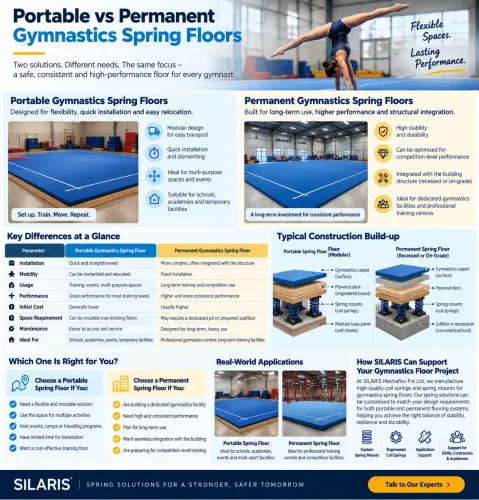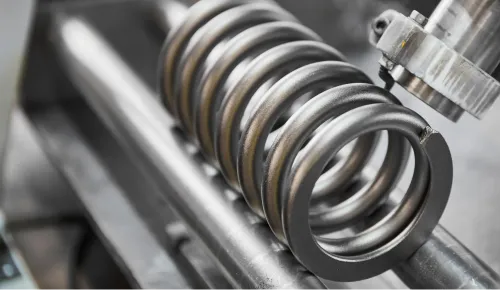
A gymnastics spring floor is much more than a layer of plywood placed over springs.
The springs, mounting system, structural boards and top surface work together to create the floor's overall feel and performance. Among these components, plywood or structural board thickness is particularly important because it determines how the deck behaves when gymnasts land, jump, tumble or change direction.
Too flexible, and the floor may feel unstable or inconsistent.
Too rigid, and the spring system may not deliver the intended resilient response.
The right combination creates a floor that feels stable underfoot while still providing controlled resilience and energy return.


6
What Is the Role of Plywood in a Gymnastics Spring Floor?
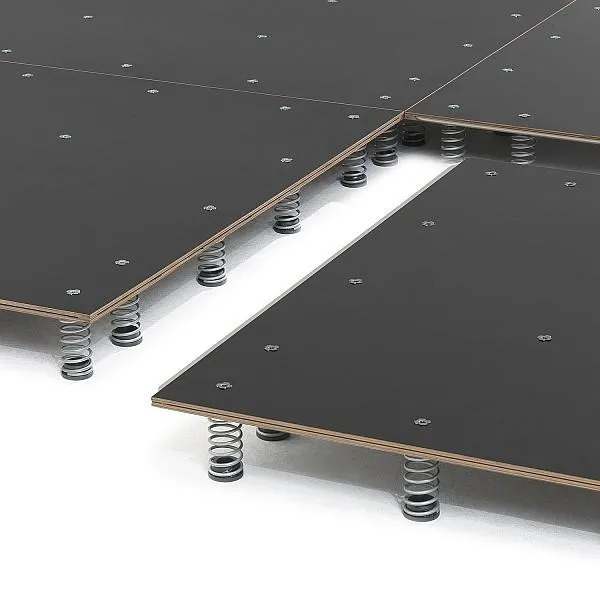
In a typical sprung gymnastics floor, the structural deck sits above the spring or resilient support system.
A simplified construction may look like:
Base → Spring Mounts → Structural Board → Surface Layer
Depending on the design, additional resilient or acoustic layers may also be incorporated.
The structural board has several jobs:
- Distribute loads across multiple spring supports
- Provide a stable surface for gymnastics activity
- Connect the individual spring-support points into a continuous deck
- Control local deflection
- Contribute to the overall stiffness of the floor
- Provide a suitable base for the upper flooring layers
Therefore, plywood thickness isn't merely a material specification. It is part of the overall structural behaviour of the spring floor.
Why Does Plywood Thickness Matter?
When a gymnast lands on the floor, the load isn't applied evenly across the entire floor.
The force is introduced over a relatively small area and then distributed through the structural deck and spring system.
The plywood needs sufficient stiffness to distribute that load without excessive local bending.
This creates an important balance:
Spring Flexibility + Deck Stiffness = Overall Floor Response
Changing the thickness of the deck can therefore change how the complete floor feels.
1. Thicker Board Generally Provides Greater Bending Stiffness
For a board acting as a structural deck, thickness has a strong influence on bending stiffness.
For a simplified beam model, bending stiffness is related to the second moment of area, which increases approximately with the cube of thickness when other dimensions and material properties remain constant.
In practical terms, increasing board thickness can substantially increase resistance to bending.
However, a gymnastics spring floor is a two-dimensional structural system, not simply a single beam, so actual performance also depends on board dimensions, joints, support spacing, material properties and construction.
2. Plywood Helps Distribute Loads Between Springs
Imagine a gymnast landing directly above one spring mount.
Ideally, the structural deck doesn't allow that one spring to carry the entire impact independently.
The deck distributes the applied force across neighbouring support points.
This is one reason the relationship between:
Board thickness + board stiffness + spring spacing
is so important.
A deck that is too flexible relative to its support arrangement may produce excessive local deflection or an inconsistent feel.

5
3. Thickness Affects Floor Stability
Gymnasts need a floor that feels predictable.
During tumbling and landings, excessive local movement can make the surface feel unstable.
The structural deck should provide enough stiffness to maintain a stable platform while allowing the spring system underneath to provide the intended resilience.
This is especially important when designing a floor with closely spaced spring mounts.
4. Thickness Influences the Interaction With Spring Mounts
The springs underneath the deck and the structural board above them should be considered as one system.
For example, suppose a spring floor uses a regular grid of spring mounts.
If the board is too flexible for the support spacing, the board itself can become a significant source of deflection.
If the board is sufficiently stiff, more of the intended movement can be controlled by the spring supports.
This is why changing plywood thickness without reassessing the spring arrangement isn't always advisable.
Single-Layer vs Multi-Layer Deck Construction
Gymnastics spring floors can use different structural deck configurations depending on the design.
One approach is a single structural board layer.
Another approach is a multi-layer deck, where boards are arranged in layers with joints positioned appropriately.
A multi-layer configuration can provide advantages in:
- Load distribution
- Structural stiffness
- Joint management
- Surface continuity
- Overall deck stability
However, the exact board thicknesses and layer configuration should be determined according to the floor's structural design, intended use and applicable requirements.


6
Is Thicker Plywood Always Better?
No.
This is one of the most important points when designing a gymnastics spring floor.
Simply increasing plywood thickness doesn't automatically produce a better floor.
A thicker deck may:
- Increase structural stiffness
- Add weight
- Change the relationship between the deck and spring supports
- Affect the floor's overall dynamic response
- Change installation requirements
The spring characteristics, support spacing and deck construction must therefore be considered together.
The goal is not:
'Use the thickest board possible.'
The goal is:
'Use a board configuration that provides the required stiffness and load distribution for the complete floor system.'
Plywood Thickness and Spring Spacing Work Together
Consider two floors:
Floor A
- Thinner structural deck
- Closely spaced spring mounts
Floor B
- Thicker structural deck
- Wider spring spacing
Even if both floors use similar springs, they may not feel the same.
Why?
Because the structural deck determines how loads travel between support points.
This is why spring spacing and plywood thickness should be evaluated together.


5
What About Two Layers of Plywood?
Using two structural layers can be useful when a floor design requires increased stiffness and better load distribution.
The two layers can work together as a composite deck when appropriately designed and installed.
Important considerations include:
- Board thickness
- Board grade
- Joint arrangement
- Fastening method
- Support spacing
- Spring location
- Overall floor dimensions
- Surface finish
The layers should not simply be stacked without considering how they interact structurally.
Plywood Grade Matters Too
Thickness is only one part of the equation.
The quality and grade of the board also matter.
Important properties include:
Strength
The board should have adequate structural strength for the expected loads.
Stiffness
Consistent stiffness helps provide predictable floor behaviour.
Dimensional Stability
Boards should maintain their dimensions reasonably well under expected environmental conditions.
Surface Quality
The surface should be suitable for the intended upper flooring system.
Manufacturing Consistency
Variation between boards can contribute to inconsistent floor performance.
Plywood vs Other Structural Boards
Depending on the application and design, a spring floor may use different structural board materials.
Common considerations include:
- Plywood
- Engineered wood panels
- Structural composite boards
- Other engineered decking materials
The appropriate choice depends on factors such as:
- Structural requirements
- Available board dimensions
- Moisture conditions
- Weight
- Fastening method
- Cost
- Intended floor performance
For a professional gymnastics facility, material selection should be based on the complete floor design rather than price alone.
How Plywood Thickness Affects Different Parts of the Floor
Floor RequirementInfluence of Deck ThicknessLoad distributionAffects how load spreads between supportsLocal stiffnessThicker deck generally increases stiffnessSurface stabilityContributes to a more stable structural platformSpring interactionChanges how much movement comes from deck vs springsFloor weightIncreasing thickness adds weightInstallationMay affect handling and fasteningDynamic responseInfluences the combined spring-deck behaviour
The exact effect depends on the material properties, board dimensions, support spacing and complete floor construction.
The Importance of Spring Mount Spacing
Plywood thickness cannot be considered independently from spring-mount spacing.
For example, if spring mounts are arranged on a regular grid, the deck must bridge the spaces between supports.
The larger the unsupported distance, the more important the deck's bending stiffness becomes.
Therefore, designers should evaluate:
Board Thickness + Board Properties + Spring Spacing + Load + Spring Characteristics
as a complete system.
Don't Forget the Fastening System
The connection between the structural deck and spring mounts is also important.
A properly designed spring floor should consider:
- Fastener type
- Fastener length
- Fastener spacing
- Mounting position
- Board thickness
- Spring-mount geometry
- Edge distances
A structurally appropriate board can still perform poorly if the connection between the spring mounts and deck isn't properly designed.
Environmental Conditions Matter
Wood-based boards can respond to changes in moisture and temperature.
A gymnastics facility may experience:
- Seasonal humidity changes
- Air-conditioning
- Temperature variations
- Cleaning moisture
- Storage conditions
Therefore, material selection and installation should take the expected environment into account.
Proper storage, acclimatisation and installation practices can help reduce unwanted dimensional changes.
Common Mistakes When Choosing Plywood for a Spring Floor
❌ Choosing Thickness Based Only on Cost
A cheaper board may not provide the required stiffness or consistency.
❌ Assuming Thicker Always Means Better
The deck must work with the spring system.
❌ Ignoring Spring Spacing
Board stiffness and support spacing are closely related.
❌ Using Inconsistent Board Grades
Variations in material properties can affect the consistency of the floor.
❌ Ignoring Joint Layout
Poorly positioned joints can affect deck continuity and local stiffness.
❌ Focusing Only on the Top Surface
The structural deck underneath plays a major role in the floor's behaviour.
❌ Changing Board Thickness Without Rechecking the System
Changing the deck changes the relationship between the board and springs.
A Practical Approach to Selecting Plywood Thickness
Before finalising the structural board, consider:
Step 1 — Define the Intended Use
Is the floor for:
- Gymnastics training?
- Professional gymnastics?
- Tumbling?
- Acrobatics?
- Multipurpose sports use?
Step 2 — Determine Spring Arrangement
Establish spring type, support spacing and expected deflection.
Step 3 — Determine Structural Loads
Consider gymnast loads, equipment loads and other expected loading conditions.
Step 4 — Evaluate Deck Stiffness
Determine whether the proposed board configuration provides the required load distribution and local stiffness.
Step 5 — Evaluate the Complete Layer System
Consider:
Base + Spring Mounts + Structural Deck + Surface System
rather than evaluating plywood independently.
Step 6 — Check Installation Details
Review joints, fasteners, board orientation and support locations.
How SILARIS Can Support Gymnastics Spring Floor Projects
At SILARIS Mechaflex Pvt Ltd, we understand that a gymnastics spring floor is a system—not simply a collection of springs and boards.
SILARIS can support requirements related to:
- Gymnastics spring mounts
- Spring-based flooring systems
- Custom coil springs
- Spring support components
- Spring mount layouts
- Application-specific spring solutions
For a spring-floor project, factors such as spring spacing, spring characteristics, deck configuration, board thickness, mounting arrangement and intended application can be considered together.
This application-focused approach can be useful for gymnastics academies, sports facility developers, flooring contractors, architects, sports equipment manufacturers and project consultants.
For projects using a specific structural deck configuration, SILARIS can work around the spring-support requirements so that the spring system and deck are considered as parts of the same overall design.
Final Takeaway
Plywood thickness matters because the structural deck is responsible for much more than simply providing a surface to walk or tumble on.
It helps distribute loads, bridge between spring supports, control local deflection and provide structural stability.
At the same time, thicker does not automatically mean better.
The ideal deck configuration depends on the relationship between board properties, thickness, spring spacing, spring characteristics, load, fastening and the overall floor construction.
For a well-designed gymnastics spring floor, the objective should be a stable, consistent and controlled response rather than simply selecting the thickest available board.
With expertise in spring-based components and custom spring solutions, SILARIS Mechaflex Pvt Ltd can support gymnastics spring-floor projects by helping coordinate the spring-support side of the system with the required application and deck configuration.
Keywords
- Gymnastics spring floor
- Gymnastics spring floor plywood
- Plywood thickness for gymnastics spring floor
- Gymnastics floor plywood
- Spring floor construction
- Gymnastics spring floor design
- Gymnastics spring mounts
- Spring floor plywood thickness
- Sprung floor construction
- Gymnastics flooring
- Gymnastics floor springs
- Spring floor support
- Gymnastics flooring system
- Plywood for gymnastics floor
- Structural deck for spring floor
- Why plywood thickness matters in a gymnastics spring floor
- What plywood thickness is used for gymnastics spring floors
- How to choose plywood for a gymnastics spring floor
- Best plywood for gymnastics spring floor construction
- How plywood affects gymnastics spring floor performance
- Plywood and spring spacing in gymnastics floors
- Double layer plywood gymnastics spring floor
- Gymnastics spring mount manufacturer in India
- Gymnastics spring floor components manufacturer
- Custom spring mounts for gymnastics flooring
- Gymnastics spring floor manufacturer India
- Spring floor solutions for gymnastics academies
#GymnasticsSpringFloor #GymnasticsFlooring #SpringFloor #SprungFloor #GymnasticsSprings #GymnasticsSpringMounts #PlywoodFlooring #PlywoodThickness #GymnasticsEquipment #SportsFlooring #SportsInfrastructure #GymnasticsAcademy #GymnasticsTraining #SpringFloorConstruction #SpringFloorDesign #SportsFacility #CustomSprings #IndustrialSprings #SpringMounts #MadeInIndia #IndianManufacturing #SILARIS #SILARISMechaflex
Keywords