Hospitals are among the most vibration-sensitive buildings we design and operate.
From AHUs, chillers, pumps and cooling towers to medical equipment and critical building services, mechanical systems can generate vibration that travels through floors, ceilings, piping and structural connections.
In an ordinary commercial building, this may be experienced mainly as an annoyance.
In a hospital, however, unwanted vibration can affect patient comfort, acoustic conditions, sensitive spaces and the performance environment of certain medical and laboratory equipment.
That is why vibration isolation should not be treated as an afterthought. It should be considered during equipment selection, structural design, MEP planning and installation.


7
What Is Vibration Isolation?
Vibration isolation is the process of reducing the transmission of mechanical vibration from a vibrating source to the structure or surrounding environment.
For example, consider an AHU installed on a building floor.
Without an appropriate isolation arrangement, vibration generated by the rotating components can travel through:
AHU → Equipment Base → Floor → Building Structure
The vibration can then reach adjacent rooms and other parts of the building.
A properly designed isolation system introduces a resilient element between the equipment and its supporting structure.
The simplified path becomes:
AHU → Vibration Isolator → Supporting Structure
The objective is to reduce the force transmitted into the structure.
Why Is Vibration Isolation Particularly Important in Hospitals?
A hospital contains a wide variety of spaces with different sensitivity levels.
These can include:
- Patient rooms
- Intensive care areas
- Operating theatres
- Diagnostic imaging areas
- Laboratories
- Consultation rooms
- Recovery areas
- Pharmacies
- Medical equipment rooms
- Mechanical rooms
At the same time, hospitals often have extensive HVAC and mechanical infrastructure operating for long periods.
This creates an interesting engineering challenge:
The equipment needs to operate reliably, while the surrounding environment needs to remain as quiet and stable as practical.
1. Patient Comfort and Acoustic Environment
Mechanical vibration can contribute to structure-borne noise.
Fans, pumps, compressors and other rotating machinery can transmit vibration through their mounting structures.
If vibration isolation is inadequate, occupants may experience:
- Low-frequency noise
- Structure-borne sound
- Floor or wall vibration
- Audible equipment noise
- Disturbance in quiet areas
Good vibration isolation therefore forms part of the overall acoustic strategy of a hospital.
2. Sensitive Medical and Diagnostic Equipment
Some hospital equipment and laboratory systems can be sensitive to environmental vibration.
Depending on the equipment and application, vibration considerations may be important for areas containing:
- Imaging equipment
- Precision diagnostic systems
- Laboratory instruments
- Research equipment
- Microscopes
- Sensitive measurement equipment
The vibration requirement should come from the equipment manufacturer's specifications and the project design criteria.
It is important not to assume that one type of isolator is suitable for every piece of medical equipment.


5
3. HVAC Systems Can Become a Major Vibration Source
Hospitals depend heavily on HVAC systems.
Air-handling units, pumps, fans, chillers and other mechanical equipment can operate continuously or for extended periods.
Common vibration sources include:
AHUs
Fan rotation and motor operation can generate mechanical vibration.
Chilled-Water Pumps
Pump imbalance, alignment problems and rotating components can transmit vibration into piping and supporting structures.
Chillers
Compressors and rotating machinery can generate significant dynamic forces.
Cooling Towers
Fans and rotating assemblies can transmit vibration through their structural supports.
Exhaust Fans
Roof-mounted and mechanical-room exhaust systems can become significant sources of structure-borne vibration.
This is why vibration isolation should be considered as part of the complete mechanical system, rather than as an isolated component.
Vibration Can Travel Through More Than the Equipment Base
One of the most common misconceptions is that installing an isolator underneath equipment automatically solves every vibration problem.
In reality, vibration can find alternative transmission paths.
For example:
Equipment → Isolator → Floor
may be properly isolated, while vibration simultaneously travels through:
Equipment → Pipe → Pipe Support → Structure
or:
Equipment → Duct → Building Connection
This is sometimes referred to as a flanking or bypass path.
Therefore, effective vibration control requires attention to the complete installation.


6
Key Factors When Selecting Hospital Vibration Isolators
Choosing an isolator should not simply be based on equipment size.
Several parameters should be evaluated.
1. Equipment Operating Weight
The isolator must be selected based on the actual supported operating load.
This may include:
- Equipment weight
- Operating fluid
- Accessories
- Base frame
- Connected components
The load should then be distributed appropriately across the individual isolator locations.
2. Load Per Isolator
An isolator supporting 250 kg is experiencing a very different condition from one supporting 1,000 kg.
Therefore:
Total Equipment Weight ÷ Number of Supports ≠ Always the Actual Load
The actual load distribution should be considered because the centre of gravity and support arrangement can result in unequal loading.
3. Static Deflection
Static deflection is one of the important parameters in spring vibration isolation.
Generally, the relationship between:
Mass + Spring Stiffness → Natural Frequency
is fundamental to vibration isolation design.
The isolator should be selected to achieve the required deflection and isolation characteristics for the equipment.
4. Operating Speed and Disturbing Frequency
The equipment's operating speed is another important consideration.
For rotating equipment, the operating frequency should be considered together with the isolator's natural frequency.
The objective is to achieve the required separation between the disturbing frequency and the isolation system's natural frequency.
5. Type of Isolator
Depending on the application, solutions may include:
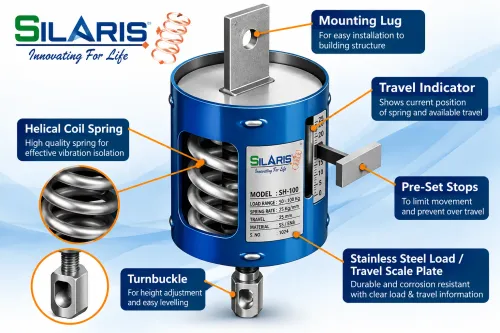
- Spring vibration isolators
- Hanger vibration isolators
- Rubber isolators
- Spring-and-rubber combinations
- Neoprene-based isolators
- Inertia bases
- Isolated equipment bases
- Resilient supports
The appropriate solution depends on the equipment, loading, frequency characteristics, required deflection and installation environment.
Floor-Mounted vs Hanger Vibration Isolation in Hospitals
Different HVAC components require different mounting arrangements.
Floor-Mounted Vibration Isolators
These are commonly used under equipment such as:
- AHUs
- Pumps
- Chillers
- Fans
- Compressors
- Other floor-mounted mechanical equipment


6
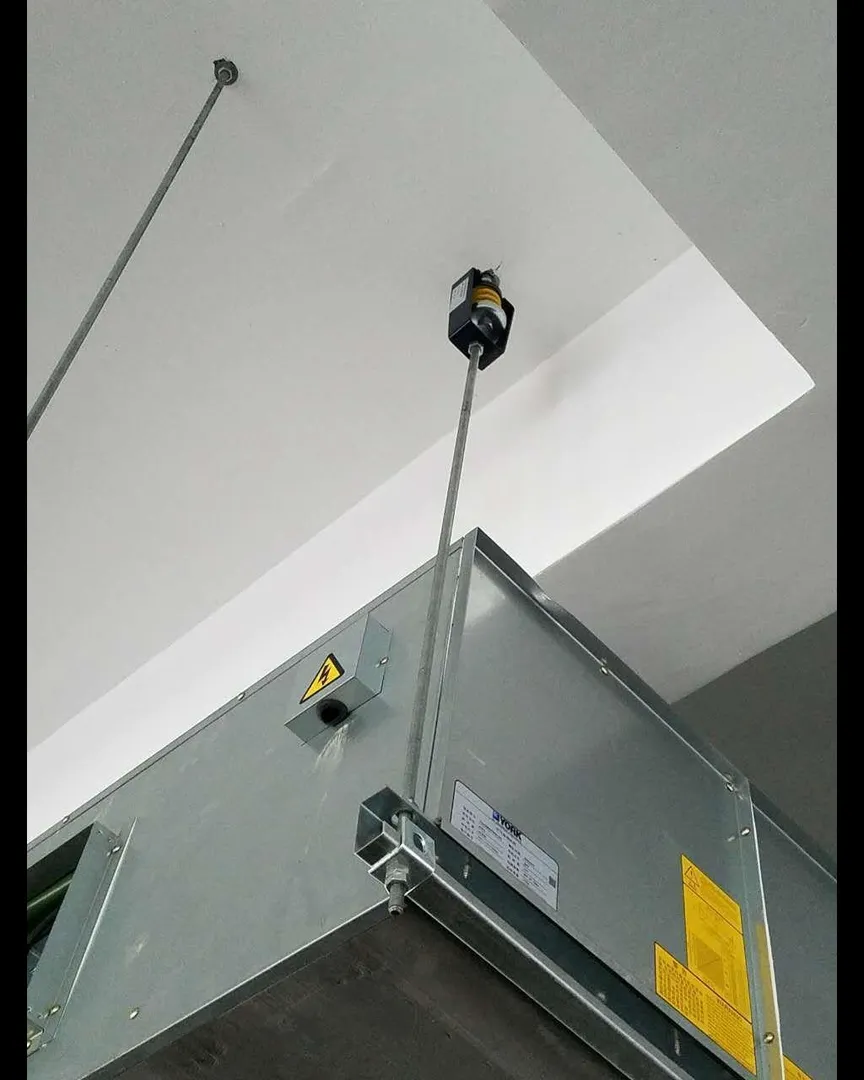
Hanger Vibration Isolators
Suspended systems may use vibration isolation hangers for:
- Suspended AHUs
- Fan systems
- Piping
- Duct-supported equipment
- Mechanical services


6
The choice depends on the equipment configuration and how the loads are transferred to the structure.
Don't Forget the Piping and Ductwork
An isolated piece of equipment can still transmit vibration through rigid connections.
For example, an AHU may have an effective isolation system underneath it, but rigid ductwork can provide a direct mechanical path into the building structure.
Similarly, rigid piping connections can transfer vibration away from pumps and other rotating equipment.
Therefore, the installation may also require:
- Flexible duct connectors
- Flexible pipe connectors
- Properly selected pipe supports
- Resilient hangers
- Appropriate equipment bases
- Correct alignment
- Adequate clearance around isolated equipment
The exact arrangement should be established according to the project design and equipment requirements.
Common Vibration Isolation Mistakes in Hospitals
❌ Selecting Isolators Only by Equipment Weight
Weight is essential, but it is not the only selection parameter.
❌ Using the Same Isolator for Every Equipment Type
An AHU, pump and chiller may have completely different vibration characteristics.
❌ Ignoring Load Distribution
Unequal loading can result in different deflections between isolators.
❌ Rigidly Connecting Isolated Equipment
Rigid connections through piping or ductwork can create vibration bypass paths.
❌ Ignoring Equipment Operating Speed
Isolation performance depends on the relationship between disturbing frequency and isolator characteristics.
❌ Treating Installation as an Afterthought
Incorrect installation can reduce the effectiveness of a correctly designed isolation system.
Vibration Isolation Should Be Considered During Hospital Design
One of the easiest ways to create vibration problems is to think about isolation only after the mechanical equipment has already been installed.
A better approach is to consider vibration during:
Equipment Selection → MEP Design → Structural Coordination → Isolator Selection → Installation → Commissioning
This allows engineers to identify potential vibration transmission paths before they become difficult and expensive to correct.
How SILARIS Can Support Hospital Vibration Isolation Requirements
At SILARIS Mechaflex Pvt Ltd, vibration-control solutions can be developed around the actual application rather than simply selecting an isolator based on equipment dimensions.
SILARIS can support requirements involving:
- Floor-mounted vibration isolators
- Hanger vibration isolators
- Spring hangers
- HVAC equipment isolation
- Industrial coil springs
- Spring supports
- Custom spring-based solutions
- Vibration-control components for mechanical systems
For hospital projects, factors such as equipment operating weight, load per support, operating speed, required static deflection, mounting arrangement and connected services can be considered while developing the appropriate solution.
This application-focused approach is particularly useful for MEP contractors, HVAC consultants, OEMs, project consultants and procurement teams working on hospitals and other vibration-sensitive facilities.
A Practical Hospital Vibration Isolation Checklist
Before finalising an isolation system, consider:
☑ Equipment operating weight
☑ Load at each isolator location
☑ Equipment operating speed
☑ Disturbing frequency
☑ Required static deflection
☑ Required isolation performance
☑ Floor/structure characteristics
☑ Equipment centre of gravity
☑ Piping connections
☑ Duct connections
☑ Flexible connections where required
☑ Operating environment
☑ Maintenance and accessibility
☑ Equipment manufacturer's requirements
☑ Project-specific acoustic/vibration criteria
Final Takeaway
Vibration isolation in hospitals is not simply about putting springs underneath a machine.
It is about understanding the complete vibration path—from the equipment and its operating characteristics to the isolators, supporting structure, piping, ductwork and surrounding spaces.
The right solution depends on the application.
For hospitals, where mechanical systems operate alongside patient-care areas and potentially vibration-sensitive equipment, proper selection, installation and coordination of vibration isolation systems are essential parts of good MEP design.
With experience in springs and vibration-control components, SILARIS Mechaflex Pvt Ltd can support HVAC contractors, MEP consultants, OEMs and project teams with application-oriented vibration isolation solutions for hospital and other critical facilities.
Keywords
- Vibration isolation in hospitals
- Hospital vibration isolation
- HVAC vibration isolation
- Hospital HVAC vibration isolators
- Vibration isolators for hospitals
- Hospital vibration control
- Medical equipment vibration isolation
- AHU vibration isolation
- Chiller vibration isolation
- Pump vibration isolation
- Floor mounted vibration isolators
- Hanger vibration isolators
- Spring vibration isolators
- HVAC spring isolators
- Hospital HVAC systems
- Structure-borne noise in hospitals
- Why vibration isolation is important in hospitals
- How to select vibration isolators for hospitals
- Best vibration isolation for hospital HVAC equipment
- Vibration isolators for AHU in hospitals
- Spring vibration isolators for hospital HVAC systems
- Floor mounted vibration isolators for hospital equipment
- Hanger vibration isolators for hospital HVAC
- How to reduce HVAC vibration in hospitals
- Hospital mechanical equipment vibration isolation
- Vibration isolation solutions for hospitals in India
#VibrationIsolation #HospitalVibrationIsolation #HospitalHVAC #HVACVibrationIsolation #VibrationControl #HospitalEngineering #HealthcareEngineering #MEPEngineering #HVACEngineering #MedicalEquipment #AHUVibrationIsolation #ChillerVibrationIsolation #PumpVibrationIsolation #SpringIsolators #VibrationIsolators #FloorMountedIsolators #HangerVibrationIsolators #SpringHangers #StructureBorneNoise #HospitalInfrastructure #IndustrialVibrationControl #MadeInIndia #IndianManufacturing #SILARIS #SILARISMechaflex
Keywords