Piping systems may look rigid and stationary once installed, but they are constantly responding to changes in temperature, pressure, flow and operating conditions.
A chilled-water pipe may contract as its temperature changes. A steam or hot-water line can expand considerably when it reaches operating temperature. Pumps and other equipment can also introduce movement and dynamic forces into connected piping.
The important question is not whether a pipe will move.
It is whether the piping system has been designed to move in a controlled and predictable way.
This is where pipe expansion, movement and restraint systems become important.


6
What Causes Pipe Movement?
The most common cause of pipe movement is thermal expansion and contraction.
When the temperature of a pipe changes, its length changes.
A simplified relationship is:
ΔL = α × L × ΔT
Where:
- ΔL = change in pipe length
- α = coefficient of thermal expansion
- L = original pipe length
- ΔT = change in temperature
This simple equation explains why even a relatively small temperature change can produce significant movement in a long pipeline.
For example, a long hot-water or steam pipeline can experience considerably more movement than a short connection near the same equipment.
Why Controlling Pipe Movement Matters
If thermal movement is not properly accommodated, the resulting forces can affect:
- Pipe supports
- Equipment nozzles
- Flanges
- Valves
- Pumps
- Expansion joints
- Building structures
- Welded connections
- Other connected piping
Uncontrolled movement can also result in pipe stress, support loading and unwanted displacement.
The goal of a restraint system is therefore not necessarily to stop every movement.
Instead, the objective is to control where and how the piping system moves.
Pipe Movement in HVAC Systems
Pipe movement is particularly relevant in HVAC installations because heating and cooling cycles are part of normal operation.
Examples include:
- Chilled-water piping
- Hot-water piping
- Heating-water systems
- Condenser-water piping
- Steam systems
- Large plant-room piping
A pipe may experience repeated expansion and contraction as the system starts, stops, heats or cools.


6
Understanding the Main Pipe Restraint Components
A well-designed piping system may use several types of supports and restraints.
Each has a different job.
1. Pipe Anchors
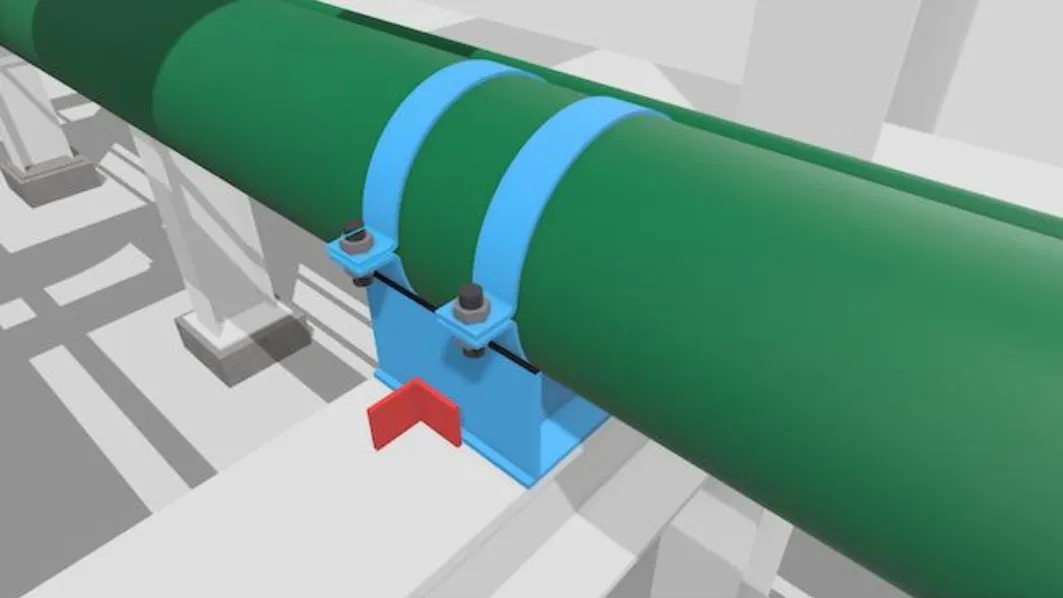
An anchor is designed to restrict pipe movement at a defined location.
Anchors divide a piping system into sections and help establish the direction in which thermal movement occurs.
They can be particularly important around:
- Expansion loops
- Expansion joints
- Long straight pipe runs
- Equipment connections
- Changes in piping direction
An anchor should be designed for the forces that it is expected to carry rather than treated simply as a heavy-duty pipe clamp.
2. Pipe Guides
Pipe guides restrict unwanted lateral movement while allowing movement in the intended direction.
For example, a guide may allow the pipe to move axially while limiting sideways displacement.
This creates a predictable movement path.
Anchor → Guide → Expansion Direction
This basic concept is widely used in thermal piping design.


5
3. Pipe Supports
Pipe supports carry the weight of the piping system.
The supported load may include:
- Pipe
- Fluid
- Insulation
- Valves
- Flanges
- Accessories
However, a conventional rigid pipe support may not always be suitable where substantial vertical movement occurs.
This is where spring supports can become useful.
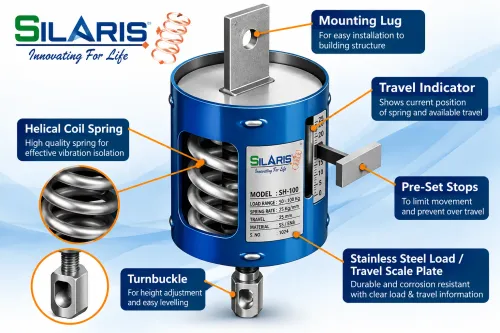
4. Spring Supports
Spring supports allow the piping system to move vertically while continuing to support its load.
They are commonly used where thermal movement creates significant vertical displacement.
Two broad categories are:
Variable Spring Supports
The supporting load changes as the spring moves.
They can be suitable where the vertical movement and allowable load variation are within acceptable limits.
Constant Spring Supports
These are designed to provide a relatively consistent supporting force over a specified travel range.
They are commonly considered for systems where substantial vertical movement occurs and maintaining a more consistent support load is important.


6
5. Thrust Restraints
Piping systems can also experience forces caused by pressure and dynamic operation.
Thrust restraints are used to control movement generated by forces acting along or around the piping system.
They can be relevant around:
- Pumps
- Flexible connections
- Expansion joints
- Large piping changes in direction
- Pressure-related movement
- HVAC mechanical equipment
Their exact design depends on the expected forces and the piping arrangement.
6. Expansion Loops
An expansion loop provides the piping with a controlled path in which thermal expansion can occur.
Instead of attempting to restrain a long pipe run completely, the geometry of the piping itself provides flexibility.
A properly designed loop can help accommodate thermal movement while controlling stress.


6
7. Expansion Joints
Expansion joints are another method of accommodating movement.
Depending on the application, expansion joints may accommodate:
- Axial movement
- Lateral movement
- Angular movement
- Vibration
- Thermal expansion
However, an expansion joint is not simply a component that can be installed anywhere in a pipeline.
Its performance depends heavily on:
- Correct sizing
- Movement requirements
- Pressure
- Temperature
- Pipe guides
- Anchoring
- Installation
- Alignment
Incorrect restraint or guiding can cause an expansion joint to operate outside its intended conditions.
Thermal Expansion vs Vibration: Don't Confuse the Two
Pipe movement and vibration are related engineering considerations, but they are not the same thing.
Thermal Movement
Usually occurs relatively slowly as the system heats or cools.
Mechanical Vibration
Can occur at much higher frequencies due to:
- Pumps
- Fans
- Compressors
- Motors
- Rotating machinery
A system may therefore need both movement management and vibration isolation.
For example, a chilled-water pump connection may require:
- Flexible connection
- Vibration isolation
- Pipe supports
- Guides
- Thrust restraint
Each component has a different function.
Why Pipe Guides and Anchors Must Work Together
One of the most important concepts in pipe movement management is that anchors and guides should be considered as part of a complete system.
Imagine a long pipe with an expansion joint but no proper guiding arrangement.
The pipe may move in an unintended direction, placing additional loads on the joint or connected equipment.
A properly coordinated arrangement establishes:
Where the pipe is restrained → Where it is allowed to move → Where the movement is absorbed
This is why restraint design should be considered during the piping-layout stage.
Pipe Movement Near Pumps and Equipment
Equipment connections deserve particular attention.
Pumps, chillers, AHUs and other mechanical equipment may have relatively sensitive nozzles and connection points.
If thermal or mechanical forces are transferred directly into equipment, they can contribute to unwanted loading.
The piping should therefore be independently supported and arranged so that the equipment connection is not unintentionally being used as a pipe support or restraint.


6
How to Select the Right Pipe Restraint System
There is no universal restraint arrangement that works for every piping system.
The following parameters should be evaluated.
1. Pipe Material
Different materials have different coefficients of thermal expansion.
Consider whether the pipe is:
- Carbon steel
- Stainless steel
- Copper
- Plastic
- Composite
2. Pipe Length
Longer pipe runs generally have greater potential for thermal movement.
A short connection and a 50-metre pipeline should not be approached in the same way.
3. Temperature Range
Determine:
Installation Temperature → Minimum Operating Temperature → Maximum Operating Temperature
The temperature range helps establish the potential thermal movement.
4. Operating Pressure
Pressure can generate additional forces, particularly around:
- Bends
- Expansion joints
- Flexible connectors
- Tees
- Changes in direction
5. Pipe Size and Weight
Larger pipes can introduce substantially greater support loads.
The total supported weight should include the contents and accessories.
6. Vertical Movement
Thermal movement isn't always horizontal.
Piping arrangements can experience vertical displacement, especially around complex equipment and structural transitions.
This is where spring supports can be particularly useful.
7. Equipment Connections
Check the allowable loads and movements at connected equipment nozzles.
The piping support system should be designed around the equipment requirements—not the other way around.
Common Pipe Expansion & Restraint Mistakes
❌ Treating Every Support as a Rigid Support
Rigid supports can unintentionally restrict thermal movement.
❌ Installing Expansion Joints Without Proper Guides
An expansion joint depends on the surrounding piping arrangement to operate correctly.
❌ Ignoring Vertical Movement
Some systems require spring supports because the pipe moves vertically during operation.
❌ Allowing Pipes to Move Uncontrolled
Uncontrolled lateral movement can create unexpected loading.
❌ Supporting Pipes From Equipment
Equipment nozzles should not inadvertently become structural supports.
❌ Ignoring Insulation and Accessories
The actual operating weight is more than the bare pipe weight.
❌ Designing Supports Without Considering Installation
A technically correct design can still perform poorly if components are installed incorrectly.
A Practical Pipe Movement Management Strategy
A useful way to approach a piping system is:
Step 1 — Identify the Movement
Determine where thermal expansion or contraction is expected.
Step 2 — Calculate the Expected Movement
Use the relevant material properties, pipe length and temperature range.
Step 3 — Establish Anchor Points
Determine where movement needs to be restrained.
Step 4 — Establish Guides
Control lateral movement and direct the pipe along the intended movement path.
Step 5 — Evaluate Vertical Movement
Determine whether conventional supports are adequate or whether spring supports are required.
Step 6 — Check Equipment Connections
Verify that thermal and mechanical loads remain within allowable limits.
Step 7 — Evaluate Expansion Devices
Where necessary, consider expansion loops or expansion joints.
Step 8 — Check the Complete System
Review piping, supports, equipment connections and structural attachments together.
How SILARIS Can Support Pipe Movement & Restraint Requirements
At SILARIS Mechaflex Pvt Ltd, spring and vibration-control solutions can be developed around the actual requirements of HVAC and industrial mechanical systems.
Depending on the application, SILARIS can support requirements involving:
- Spring supports
- Spring hangers
- Thrust restraints
- Industrial coil springs
- HVAC vibration isolators
- Floor-mounted vibration isolators
- Hanger vibration isolators
- Custom spring-based solutions
For applications involving pipe movement, parameters such as operating load, vertical movement, spring rate, support configuration and operating conditions can be considered when developing a suitable solution.
This can be particularly useful for HVAC contractors, MEP consultants, EPC companies, industrial plant engineers, OEMs and project procurement teams looking for application-specific spring and restraint components.
Pipe Expansion & Restraint Checklist
Before finalising a piping support system, ask:
☑ What is the expected thermal movement?
☑ What is the operating temperature range?
☑ What is the pipe material?
☑ What is the total operating weight?
☑ Where should the pipe be anchored?
☑ Where should lateral movement be restricted?
☑ Is vertical movement expected?
☑ Are spring supports required?
☑ Are thrust restraints required?
☑ Are expansion loops or joints required?
☑ Are equipment nozzle loads within allowable limits?
☑ Are flexible connections properly supported?
☑ Are all guides and anchors correctly positioned?
☑ Has the complete movement path been checked?
Final Takeaway
Pipes move—and good piping design plans for that movement.
Thermal expansion, contraction, pressure forces and equipment-induced movement can all influence how a piping system behaves during operation.
The objective of a good restraint system isn't necessarily to eliminate movement. It is to control movement, support the piping load and protect connected equipment and structures.
Anchors, guides, spring supports, thrust restraints, expansion loops and expansion joints each have their own role. Selecting and coordinating them correctly is what makes the overall system work effectively.
For projects requiring spring supports, thrust restraints, vibration isolators and custom spring-based solutions, SILARIS Mechaflex can support the engineering and component requirements based on the application.
Keywords
- Pipe expansion
- Pipe movement
- Pipe restraint systems
- Pipe expansion and restraint
- Thermal expansion piping
- Pipe supports
- Pipe expansion supports
- Pipe thermal movement
- Pipe anchors
- Pipe guides
- Spring supports
- Spring hangers
- Thrust restraints
- Pipe expansion joints
- Expansion loops
- HVAC pipe supports
- Industrial pipe supports
- Thermal pipe supports
- Understanding pipe expansion and movement
- How to control thermal expansion in pipes
- Pipe expansion and restraint systems for HVAC
- Pipe movement control in industrial piping
- How to select pipe restraints
- Spring supports for thermal expansion
- Pipe guides and anchors for thermal movement
- Thrust restraints for HVAC piping
- Pipe expansion support manufacturer in India
- Industrial spring support manufacturer India
- HVAC pipe expansion and movement solutions
- Custom pipe restraint and spring support solutions
#PipeExpansion #PipeMovement #PipeRestraint #PipeRestraintSystems #ThermalExpansion #ThermalMovement #PipeSupports #PipeGuides #PipeAnchors #SpringSupports #SpringHangers #ThrustRestraints #ExpansionJoints #ExpansionLoops #HVACPiping #HVACEngineering #IndustrialPiping #MechanicalEngineering #MEPEngineering #PipingEngineering #VibrationIsolation #IndustrialSprings #MadeInIndia #IndianManufacturing #SILARIS #SILARISMechaflex
Keywords